Record free fall parachute jumps
In 1914, while doing demonstrations for the U.S. Army, a parachute pioneer named Tiny Broadwick deployed her chute manually, thus becoming the first person to jump free-fall.
According to the Guinness Book of Records, Eugene Andreev (USSR) holds the official FAI record for the longest free-fall parachute jump after falling for 24,500 metres (80,400 ft) from an altitude of 25,458 metres (83,524 ft) near the city of Saratov, Russia, on 1 November 1962. Although later on jumpers would ascend higher altitudes, Andreev's record was set without the use of a drogue chute during the jump and therefore remains the longest genuine free fall record.
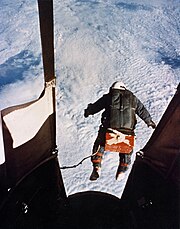
During the late 1950s, Captain Joseph Kittinger of the United States was assigned to the Aerospace Medical Research Laboratories at Wright-Patterson AFB in Dayton, Ohio. For Project Excelsior (meaning "ever upward", a name given to the project by Colonel John Stapp), as part of research into high altitude bailout, he made a series of three parachute jumps wearing a pressurized suit, from a helium balloon with an open gondola.
The first, from 76,400 feet (23,290 m) in November 1959 was a near tragedy when an equipment malfunction caused him to lose consciousness, but the automatic parachute saved him (he went into a flat spin at a rotational velocity of 120 rpm; the g-force at his extremities was calculated to be over 22 times that of gravity, setting another record). Three weeks later he jumped again from 74,700 feet (22,770 m). For that return jump Kittinger was awarded the A. Leo Stevens parachute medal.
On 16 August 1960 he made the final jump from the Excelsior III at 102,800 feet (31,330 m). Towing a small drogue chute for stabilization, he fell for 4 minutes and 36 seconds reaching a maximum speed of 614 mph (988 km/h) before opening his parachute at 14,000 feet (4,270 m). Pressurization for his right glove malfunctioned during the ascent, and his right hand swelled to twice its normal size. He set records for highest balloon ascent, highest parachute jump, longest drogue-fall (4 min), and fastest speed by a human through the atmosphere.
The jumps were made in a "rocking-chair" position, descending on his back, rather than the usual arch familiar to skydivers, because he was wearing a 60-pound (27 kg) "kit" on his behind and his pressure suit naturally formed that shape when inflated, a shape appropriate for sitting in an airplane cockpit.
For the series of jumps, Kittinger was decorated with an oak leaf cluster to his Distinguished Flying Cross and awarded the Harmon Trophy by President Dwight Eisenhower.
In 2012, the Red Bull Stratos mission took place. On 14 October 2012, Felix Baumgartner broke the records previously set by Kittinger for the highest free fall, the highest manned helium balloon flight, and the fastest free fall; he jumped from 128,100 feet (39,045 m), reaching 833.9 mph (1342 km/h) - Mach 1.24, faster than the speed of sound. Kittinger was a member of the mission control and helped design the capsule and suit that Baumgartner ascended and jumped in.
On 24 October 2014, Alan Eustace broke the record previously set by Baumgartner for the highest fall. He jumped from a height of 135,908 feet (41,425 m) and fell with a drogue chute for 4 and a half minutes.


Comments
Post a Comment